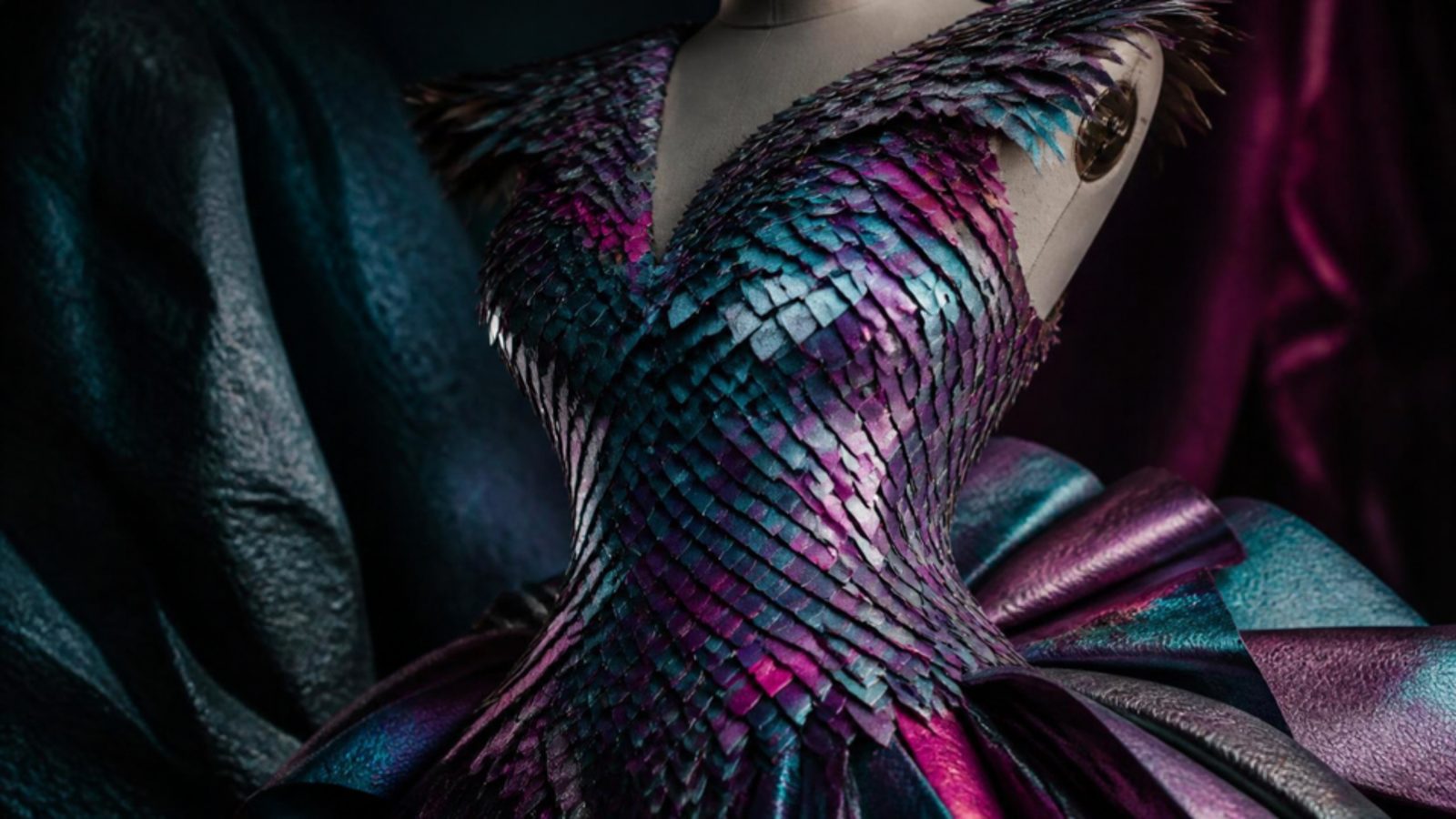
One of the most striking uses of AI at Paris Fashion Week so far didn’t generate a model, a campaign, or a single image. It routed wires. For his Spring/Summer 2027 collection, Anrealage designer Kunihiko Morinaga sent out six sculpted evening dresses covered in up to 2,000 individually controlled E Ink scales that shift color across the body, and AI was used to map the circuitry that makes it work. The show, Anrealage’s 25th in Paris, was held at the Maison de la Radio et de la Musique. It’s a useful reset on what “AI fashion” means in 2026, because the most impressive use of the technology here is one you can’t actually see.
What Anrealage Put on the Runway
The collection is called SKIN, and Morinaga built it around the idea of an outer layer that can be shed and renewed while the person underneath stays the same. “Living things shed their skin, again and again,” he said. “They slip out of the old skin and live on in the new.” His references ranged from chromatophores (the pigment cells that let some animals change color) to video-game avatar “skins” and Osamu Tezuka’s manga Phoenix.
The show started simply, with second-skin bodysuits printed with psychedelic scales and trompe l’oeil patchwork styled to look like denim and varsity jackets. It built up to the six armor-like cocktail and evening dresses, each carrying between 1,000 and 2,000 electronic-paper scales. Unlike LEDs, the scales give off no light of their own. The material itself changes color, so patterns ripple across the dress, fade to ash gray, and come back in new arrangements. Other looks used 3D-printed bustiers that change color depending on the viewing angle, Japanese washi paper with sequin details, and Toray Ultrasuede scales. The finale was a glowing look based on the Phoenix rising.
Why the AI Part Matters More Than It Looks
Reports describe AI’s role narrowly: it mapped the circuitry needed to control the system, a network of wires connecting each scale. That sounds like a footnote. It isn’t. Getting a thousand or more separately addressable elements to work on a curved garment that has to move on a walking body is a hard engineering problem. It’s the kind of layout-and-routing work that would take a human team a long time to solve by hand.
That’s the pattern we keep seeing this year, and it’s one of the clearest AI fashion trends of 2026. Last week we covered Google’s custom AI tools for two New York Fashion Week designers, which handled fittings and set planning rather than making anything the audience saw. Anrealage takes that a step further: AI as engineering infrastructure inside the garment itself. Meanwhile, AI-generated campaign imagery keeps getting called “AI slop.” The uses holding up best are the ones where the creative vision stays clearly human and the AI solves a problem people couldn’t practically solve alone.
E Ink is also a smart pairing. Electronic paper generally uses power when it switches state rather than to keep an image on screen, and it doesn’t glow. That’s why Anrealage’s dresses look like a living surface rather than a wearable screen, and it fits Morinaga’s chromatophore idea.
What We Still Don’t Know
The coverage so far leaves real gaps. None of it names the AI system used, says how the dresses are powered, how heavy they are, or how long the effect lasts. None of it says whether any version will ever be sold. These are runway showpieces, and Anrealage has a long record of tech-driven collections that stay closer to art than to retail. Morinaga’s own framing points to a longer horizon: “Perhaps those clothes will be called a third skin.”
The practical takeaway: when you see an “AI fashion” headline, ask what the AI actually did. Generating a finished image is the easy, contested part. Solving the engineering or planning problem behind a human designer’s idea is quieter, harder to fake, and increasingly where the real work is happening.
FAQ
What did AI actually do in Anrealage’s Spring 2027 collection?
According to reports from the show, AI was used to map the circuitry that controls the E Ink scales, meaning the wiring network that lets up to 2,000 scales per dress change color individually. The collection itself was designed by Kunihiko Morinaga, not generated by AI.
How is E Ink different from LED clothing?
LEDs emit light. E Ink electronic paper doesn’t. The material itself changes color, the same way an e-reader screen does. That gives Anrealage’s dresses a matte, skin-like color shift rather than a glowing screen effect.
Can you buy the color-changing dresses?
No retail plans have been reported. The six E Ink dresses were presented as runway pieces, and details like power source, weight, and durability haven’t been disclosed.
Sources & Further Reading: WWD (via Yahoo) — “Anrealage Spring 2027: Under the Skin” (Alex Wynne, September 30, 2026), https://www.yahoo.com/entertainment/articles/anrealage-spring-2027-under-skin-094924414.html; Designscene — “ANREALAGE Spring Summer 2027 Rethinks Clothing as Skin” (Jana Kostic, September 30, 2026), https://www.designscene.net/2026/09/anrealage-spring-summer-2027.html; Design and Art Magazine — “Anrealage SS27 Moves Beyond Skin Deep,” https://www.designartmagazine.com/2026/09/anrealage-ss27-moves-beyond-skin-deep.html
By Michelle Jones, Fashion News GF