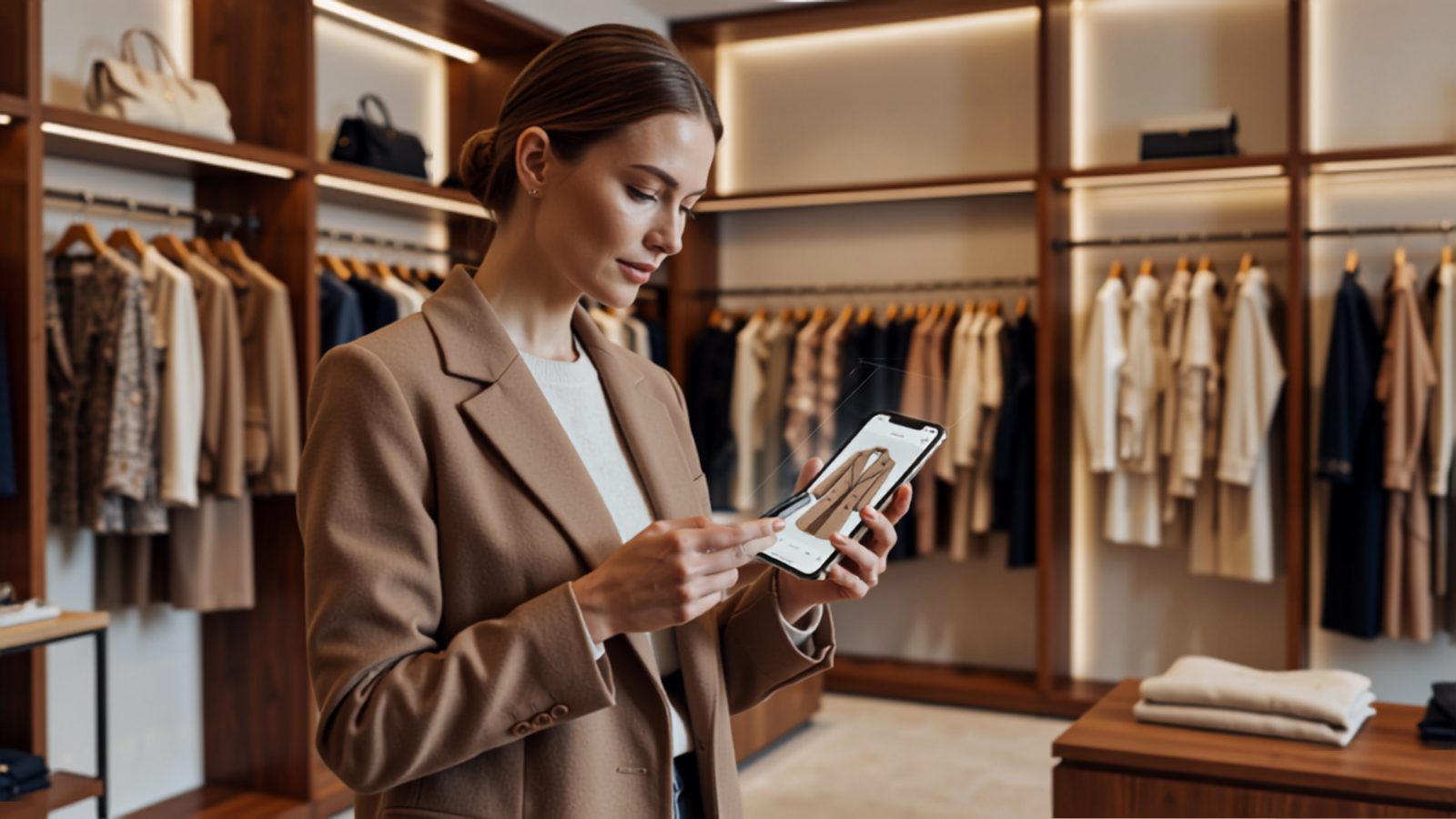
A new data set just put a real number on something the industry has been claiming for years: AI virtual try-on doesn’t just look impressive in a demo, it measurably changes whether someone actually buys. A July 2026 report from try-on company DRESSX, built from 1.2 million shoppers across 216 countries, found that luxury shoppers who used a try-on feature converted at rates up to roughly ten times higher than those who didn’t. That’s not a rounding-error improvement — it’s the kind of gap that reshapes how a fashion e-commerce team prioritizes its roadmap.
What the New Data Actually Shows
The report tracked shopper behavior across luxury platforms including Victoria Beckham, Loulou de Saison, TTSWTR, and Pascal, comparing people who engaged with an AI try-on tool against those who browsed the same catalog without it. The headline numbers:
- Cart adds: try-on users added items to cart at an 11% rate versus 4% for non-users — roughly 3x higher.
- Purchases: try-on users converted at 3% versus 2% for non-users overall, a 50% lift.
- Luxury specifically: the gap widens sharply — 10% view-to-cart for try-on users versus 2% for non-users, and 2.8% view-to-purchase versus just 0.3% for non-users.
- Retention: 49% of try-on users returned the next day versus 6% of non-users; at 30 days it was 44% versus 1%.
- Browsing depth: try-on users viewed roughly 7x more product listings and ran 25% more searches per session.
For context, average online fashion conversion sits around 1-2%, and luxury e-commerce typically converts even lower than that — often cited around 0.7-0.8% — against 23-30% for in-person retail, where shoppers can physically try something on before paying for it. That in-person advantage is exactly the gap AI try-on is designed to close.
Why the Luxury Gap Is So Much Bigger Than the Overall Number
The most interesting detail in the report isn’t the topline “50% higher” stat most coverage led with — it’s the breakdown by price tier. Engagement with try-on tools climbed steadily as price went up: about 4% of shoppers used it on items under $50, rising to 19% for $100-249, 22-23% for $250-999, and 27% for anything over $1,000.
That pattern lines up with what fashion retailers already know anecdotally: the more expensive an item is, the more a shopper needs to resolve doubt before paying for it. A $30 t-shirt is a low-stakes guess. A $900 coat is a real financial decision, and “will this actually look right on me” is often the exact thing stopping someone from checking out. AI try-on — DRESSX’s version uses silhouette mapping, fabric modeling, and generative rendering to show the garment on a shopper’s own body shape — directly answers that question before the shopper has to submit a card number. It’s also worth noting 70% of this engagement happened on mobile, where that kind of pre-purchase doubt is hardest to resolve any other way (no dressing room, no returns desk nearby).
What This Means If You’re Shopping — or Building a Fashion Site
For shoppers, the practical takeaway is simple: if a site you’re browsing offers a try-on feature, using it isn’t just a novelty — the data suggests it genuinely correlates with fewer regret purchases and fewer returns, since apparel return rates industry-wide still sit at a rough 30-40%. For anyone building or running a fashion e-commerce operation, the report is a fairly direct argument that try-on tooling belongs closer to the top of the roadmap than “nice-to-have,” particularly for anything priced above the impulse-buy threshold. We covered the broader shift of AI moving from a discovery gimmick into an actual point-of-sale tool in our recent look at AI checkout going live across major retailers — this new data is effectively the receipts for why that shift is happening.
FAQ
Does AI virtual try-on actually reduce returns, or just boost sales?
The report ties try-on usage to both — higher conversion and, separately, industry data on try-on tools generally showing meaningfully lower return rates, since shoppers have already seen a rendering of fit and drape before committing to buy.
Is this data specific to luxury brands, or does it apply to fashion e-commerce broadly?
The steepest gains were in the luxury segment specifically, but the underlying pattern — higher price, higher try-on engagement, higher conversion lift — showed up across price tiers in the full data set, not just at the top end.
What technology is actually behind these try-on tools?
DRESSX’s system, which supplied this data, combines silhouette mapping, fabric modeling, and generative AI to render how a specific garment would look on a shopper’s own body, rather than showing it on a generic model.
By Michelle Jones, Fashion News GF
Source: Business of Fashion & Marketing Tech News, coverage of the DRESSX 2026 AI Virtual Try-On Report (published July 23, 2026), https://www.marketingtechnews.net/news/ai-try-on-ecommerce-conversion-dressx-study/