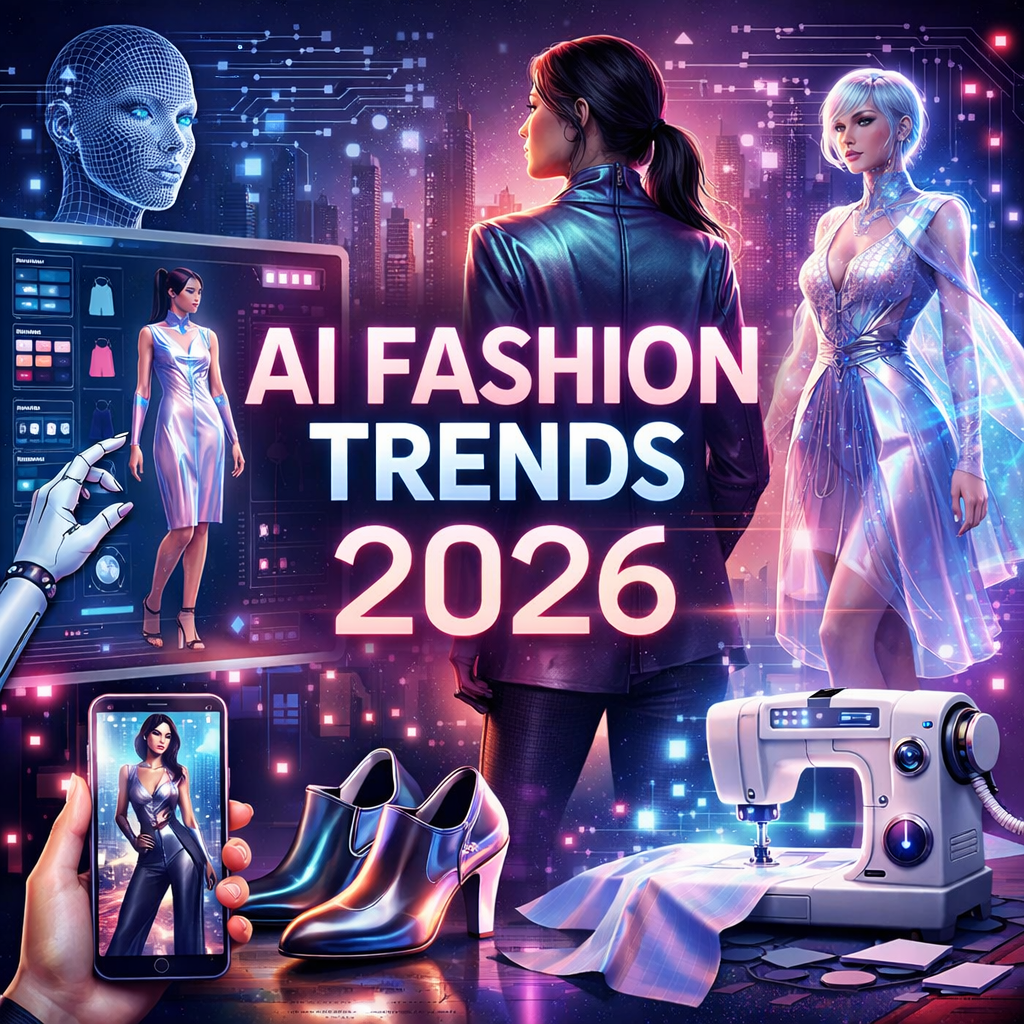
The fashion industry is no longer just trend-driven — it’s data-driven. In 2026, artificial intelligence has moved from a buzzword to the backbone of how brands design, forecast, and sell. But not every AI-powered trend is on the rise. Some are peaking, others are fading, and a few are just beginning to reshape the entire industry.
Whether you’re a brand strategist, a style enthusiast, or a buyer trying to stay ahead of the curve, understanding where each trend sits on its lifecycle can make or break your next move. To help you cut through the noise, we’ve mapped out the biggest AI fashion trends of 2026 — and exactly where each one stands right now.
Not sure where a specific trend scores on the momentum scale? Use our free AI Trend Score Checker to get a data-backed read on any style or technology trend in real time.
📈 What’s Rising: The Trends Gaining Serious Momentum
1. Agentic AI Shopping Curators
Forget scrolling through endless product pages. In 2026, agentic AI systems are autonomously curating full outfit recommendations — factoring in your calendar, location, budget, and personal aesthetic — across multiple platforms simultaneously. These aren’t simple recommendation engines; they’re intelligent shopping assistants that predict what you’ll want before you know you want it.
Major retailers are racing to integrate agentic AI into their e-commerce experience, and early adopters are already seeing a significant reduction in cart abandonment and returns. This trend is firmly in its growth phase, with mass adoption still 12–18 months away for most mid-market brands.
2. AI-Powered Virtual Try-On at Scale
Virtual try-on technology has existed for years, but 2026 marks the point where it’s actually becoming accurate, widely accessible, and genuinely useful. Google Shopping’s rollout of its AI-powered try-on tool — which maps clothing onto your own body using generative image editing — has set a new benchmark for the category.
Zara’s own AI try-on feature has already earned the label “life changing” from early users, though it’s not without its quirks. The technology still struggles with certain silhouettes, but the trajectory is clear: virtual try-on is moving from novelty to expectation. Brands not investing in this now will be playing catch-up within two years.
Want to know how your specific brand or style segment scores on virtual try-on adoption? Run it through our AI Trend Score Checker and get an instant momentum rating.
3. AI-Driven Sustainable Fashion Optimization
Sustainability is no longer just a marketing talking point — AI is making it operationally measurable. From demand forecasting that reduces overproduction to computer vision tools that detect garment wear levels in secondhand markets, AI is actively helping brands cut waste at every stage of the supply chain.
The circular economy has received a particular boost: resale platforms are now using AI to automatically categorise and price second-hand items, with dynamic algorithms adjusting in real time based on trend relevance and condition. With 12.4% of Americans now using GLP-1 medications, even inventory planning is getting an AI-assisted overhaul as body size distributions shift across the population.
4. Micro-Trend Detection & Real-Time Forecasting
Traditional trend forecasting ran on seasonal cycles. AI-powered forecasting runs on minutes. Platforms now analyse TikTok content, runway footage, search behaviour, and customer reviews simultaneously — detecting micro-trends (the rise of a specific sleeve shape, a new fabric texture, an emerging colour story) before they surface in mainstream awareness.
For brands that move quickly, this is a genuine competitive advantage. A style trending on TikTok today can peak within two weeks — and traditional forecasting reports won’t capture it for months. The brands winning right now are those that have integrated live AI dashboards into their merchandising and buying workflows.
⚡ What’s Peaking: At the Top — But Watch for the Plateau
5. AI Virtual Influencers
AI-generated virtual influencers have had a remarkable run. Powered by large language models and 3D modelling, these digital avatars post content around the clock, carry no reputational risk, and can be A/B tested across platforms for maximum engagement. Brands have embraced them as risk-free, cost-efficient alternatives to celebrity ambassadors.
But the trend is showing early signs of saturation. Audiences are growing more discerning about authenticity, and a cultural backlash against obviously AI-generated content is building — particularly among Gen Z, who simultaneously celebrate digital creativity and reject perceived corporate manipulation. The brands that will succeed with virtual influencers going forward are those who lean into transparency rather than trying to pass AI avatars off as human.
6. Generative AI Design Tools
Tools like Midjourney, DALL·E, Adobe Firefly, and specialised platforms like Fashion Diffusion are now standard in many design studios. The ability to turn a text prompt into a photorealistic garment sketch, or a rough concept into a fully rendered 3D prototype, has dramatically compressed design timelines.
This trend is peaking in the sense that it’s now nearly ubiquitous among larger brands — which means the competitive edge it once offered is flattening. The next phase of this story isn’t about whether brands use generative AI design, but how they use it to maintain a distinct creative identity rather than blending into a sea of algorithmically homogenised aesthetics.
7. AI-Generated Personalised Fashion Recommendations
Netflix-style personalisation has arrived in fashion. AI systems that learn your style preferences, body shape, budget, and purchase history to serve hyper-relevant product recommendations are now table stakes for major e-commerce players.
The technology itself is mature and effective — but consumer trust issues are emerging. Shoppers are increasingly aware that these systems are designed to maximise purchase frequency, not wardrobe quality, and a growing segment is actively resisting algorithmic curation in favour of more intentional purchasing. The recommendation engine trend is peaking; the next evolution will be AI tools that genuinely help shoppers buy less and buy better.
Curious how the personalisation trend rates in your specific market segment? Check it on the AI Trend Score Checker for a real-time score.
📉 What’s Declining: Losing Steam in 2026
8. Generic AI Content in Fashion Marketing
The era of brands churning out AI-generated imagery and copy without meaningful human oversight is running into a wall. Consumer backlash against obviously AI-generated visuals — particularly in fashion, where aesthetic authenticity is core to brand identity — is intensifying.
This backlash isn’t just cultural noise. It has real commercial consequences. Brands that leaned too heavily on AI imagery in 2024–2025 are now walking it back, investing in hybrid workflows where AI tools support human creatives rather than replace them. The lesson: AI in fashion marketing works best as an accelerant for human creativity, not a substitute for it.
9. Fully Automated AI Trend Reports (Without Human Context)
Early adopters paid significant money for AI-generated trend reports that promised to decode the future of fashion through data alone. In practice, many of these reports turned out to be statistically coherent but contextually hollow — identifying signals without understanding the cultural nuance behind them.
The market has corrected. The most effective forecasting tools in 2026 combine machine learning with genuine human editorial expertise. Pure automation without human curation is declining as a viable product category.
10. Seasonal AI “Trend Dumps”
The idea of releasing a big, annual AI-curated trend report — a batch-processed list of what’s “in” and “out” for the season — is becoming obsolete. The fashion cycle has fragmented so dramatically that a static seasonal forecast is outdated before it’s published. Brands are shifting toward always-on AI monitoring systems rather than periodic trend drops, making the traditional seasonal dump model increasingly redundant.
🔮 The Bigger Picture: What This All Means for Fashion in 2026
The clearest pattern across all of these trends is this: AI in fashion rewards integration, not replacement. The tools that are rising are those that amplify human creativity, speed, and decision-making. The ones that are declining are those that tried to cut humans out of the equation entirely.
There’s also a growing reckoning with what might be called the homogenisation problem — when everyone uses the same AI tools trained on the same data, the risk is that fashion becomes less diverse, not more. The brands that will define the next chapter of AI in fashion are those that use these tools to deepen their creative identity, not dilute it.
For shoppers, the shift is equally significant. AI is making fashion more personalised, more accessible, and more sustainable — but it’s also raising new questions about authenticity, data privacy, and the value of human craftsmanship in a world of infinite AI-generated options.
Stay Ahead with Data-Backed Trend Intelligence
Understanding where a trend sits in its lifecycle — rising, peaking, or declining — is one of the most valuable pieces of intelligence a brand or buyer can have. Acting on a trend that’s already past its peak is as costly as missing one that’s just beginning to surge.
That’s exactly why we built the AI Trend Score Checker. It’s a free tool that gives you an instant, data-backed momentum score for any fashion or AI trend — so you can make smarter decisions about where to invest your attention, budget, and creative energy.
→ Try the AI Trend Score Checker for free
Final Thought
AI is not the future of fashion — it’s the present. The question is no longer whether to engage with these technologies, but how to do so with enough intelligence and intentionality to stay ahead of the pack. The brands and buyers who understand the lifecycle of each trend, rather than just reacting to what’s loud right now, will be the ones setting the agenda in the seasons ahead.
Bookmark this article and revisit it quarterly — the lifecycle of each trend above will shift, and knowing when something has moved from rising to peaking (or peaking to declining) is where the real competitive edge lives.